Wildfire History
The 2024 South American Wildfires: What Burned, and Why Early Detection Matters
In 2024, fire burned an area of South America larger than Texas and killed at least 148 people. Almost every one of those fires began as something small. Here is what burned, in charts and numbers, and how much could have been saved by seeing fire sooner.
The 2024 South American wildfires burned an area larger than Texas, sent smoke as far as Buenos Aires and killed at least 148 people. Yet every one of those fires began as something small: an escaped field burn, a spark, a match. For a few minutes, most could have been stopped by a handful of people. Too often, those minutes were gone before help could arrive. This is the story of what burned, in charts and numbers, and of how much could have been saved by seeing fire sooner.
- Land burned 73.7 million hectares (182 million acres) in current satellite data. An earlier figure, 858,669 km², is also widely quoted.
- Lives lost At least 148 people, most of them in Chile's February fires.
- Fire detections 346,112 hotspots by September 11, a record for that date.
- Carbon The continent's highest fire emissions on record, 84% above average.
Key takeaways
- Brazil and Bolivia accounted for 78% of the area burned. In Bolivia, the area was double that of 2023.
- People started the great majority of these fires, which means most began near roads, farms and villages: places that can be watched.
- In Chile, one fire grew from 8 to 80 hectares in 81 minutes.
- In Australian research, reaching a fire early at least doubled the chance of stopping it on the first attack.
- Early detection, with a crew ready to respond, is the best chance to keep a spark from becoming a catastrophe.
How much burned in the 2024 South American wildfires?
The figure quoted most often is 858,669 km² (85.9 million hectares, or 212 million acres). It comes from Wikipedia, which credits the Global Wildfire Information System (GWIS), a satellite monitoring service. Satellite records are revised over time. The GWIS data published today puts the 2024 total for South America at 73.7 million hectares (737,349 km²). Either way, it is an area larger than Texas.
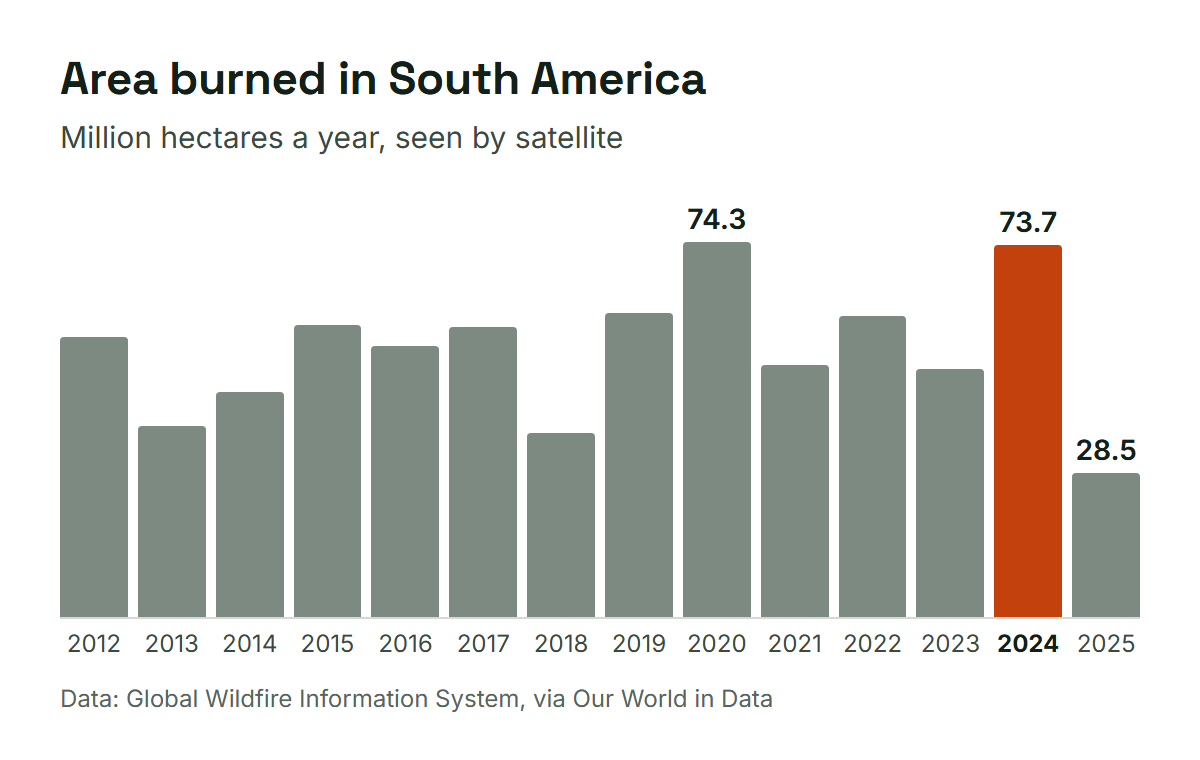
Totals depend on the method. Satellites that map only larger burn scars report less, and GWIS counts farmland and grassland as well as forest. What every source agrees on is that 2024 was extreme.
Country by country
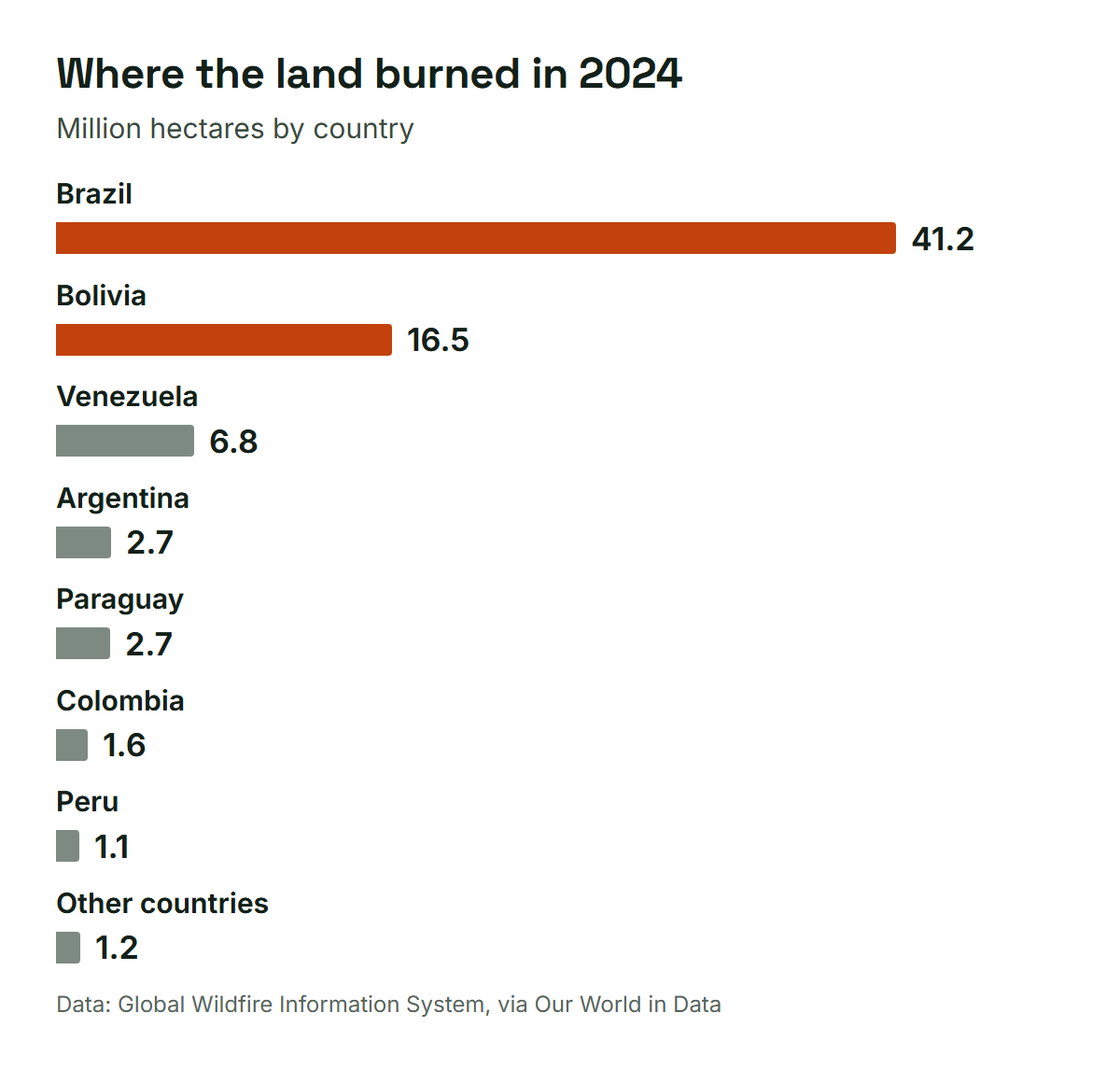
| Country | 2023 (ha) | 2024 (ha) | Change |
|---|---|---|---|
| Brazil | 27,486,276 | 41,233,964 | +50% |
| Bolivia | 7,907,524 | 16,476,522 | +108% |
| Venezuela | 4,749,631 | 6,781,563 | +43% |
| Argentina | 2,816,682 | 2,702,774 | −4% |
| Paraguay | 2,746,807 | 2,658,448 | −3% |
| Colombia | 1,616,134 | 1,556,254 | −4% |
| Peru | 612,240 | 1,138,651 | +86% |
| South America | 49,228,988 | 73,734,856 | +50% |
Inside Brazil
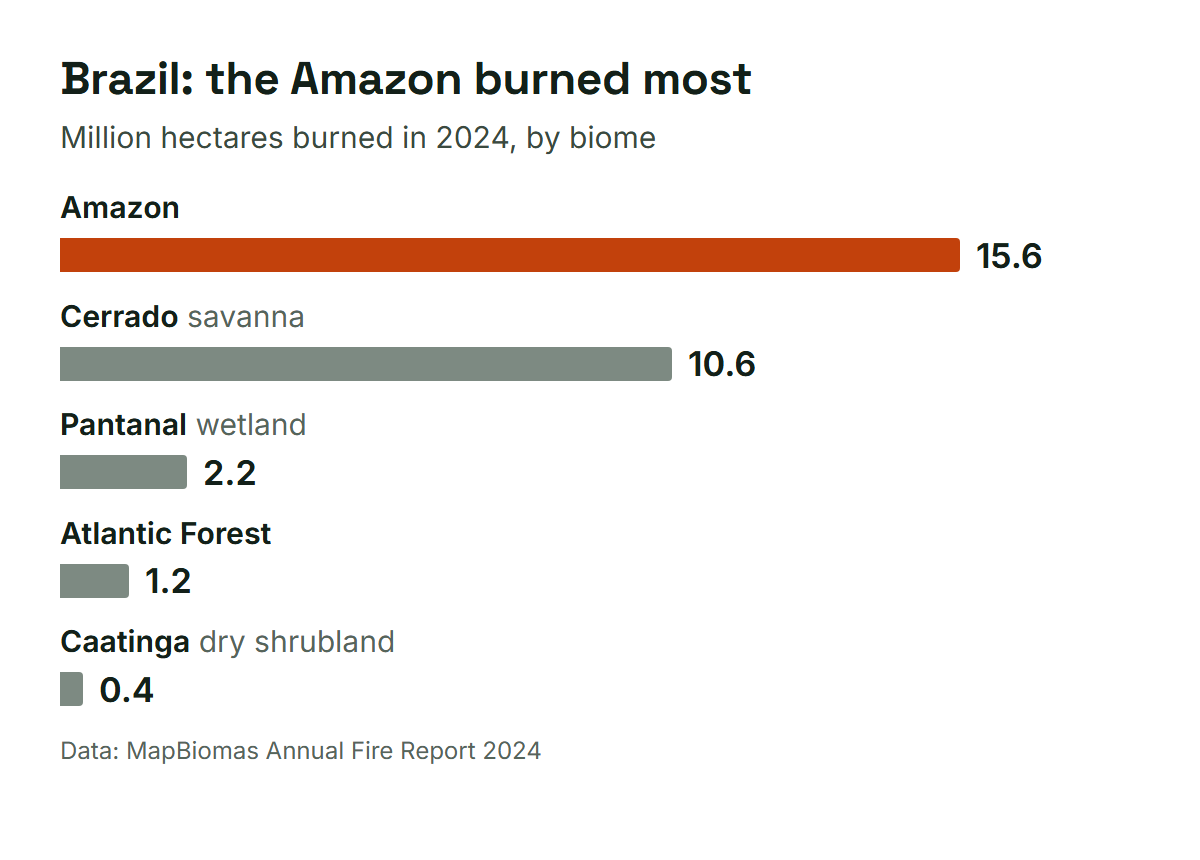
Brazil's own mapping network, MapBiomas, uses a different method and counts 30 million hectares in 2024, 62% above the long-term average. The Amazon had its largest burned area since records began in 1985.
Timeline: how the year unfolded
- January–March: Northeast Amazonia burns. Forest fire extent there is more than four times the average, a record.
- February 2–5: Fires race through Viña del Mar and Quilpué in Chile, killing at least 131 people.
- June: About 2,500 fires are identified in the Pantanal, the world's largest tropical wetland, the highest June count since 1998.
- August–September: Fire crosses the Pantanal and the Chiquitano dry forest of Brazil and Bolivia. Its extent is twice the previous record.
- September: Peru counts at least 15 deaths. By September 11, satellites have logged 346,112 hotspots across the continent.
- September 30: Bolivia declares a national disaster.
What caused the 2024 wildfires?
Drought set the stage
Years of low rainfall left forests, wetlands and grasslands ready to burn. The State of Wildfires 2024–2025 report found that climate change made the fire weather in the Pantanal and Chiquitano four to five times more likely.
People lit the match
Drought does not start fires. A study cited in an Imperial College analysis attributes only about 1% of fires in Brazil to natural causes such as lightning. The rest trace back to people: land clearing, pasture burning, escaped field fires and arson. In northeast Amazonia, the State of Wildfires report puts the human share above 90%. Peru's prime minister said that all the fires burning in the country had been started by humans. In Chile, prosecutors charged nine people over the February fires.
This matters for prevention. Fires lit by people start where people are. They can be found early, if someone or something is watching.
The human and natural toll
Lives, homes and health
Wikipedia's compilation lists 148 deaths, which matches 131 in Chile, 15 in Peru and 2 in Brazil. It includes none from Bolivia, so the real toll is probably higher. Around 14,000 homes were affected in Viña del Mar and Quilpué alone. In Bolivia, smoke, displacement and school closures affected more than 145,000 children and teenagers.
Smoke carried the disaster far beyond the flames. Fine particle pollution in the Pantanal–Chiquitano region reached up to 60 times the World Health Organization's daily limit. Agribusiness there lost about US$222 million.
Forests and climate
Fire damaged 3.3 million hectares of Amazon forest and released an estimated 791 million tons of carbon dioxide, seven times the average of the previous two years. In Bolivia, more than 9% of the remaining intact forest was affected. Trees that took centuries to grow were lost to fires that began in a moment.
Every one of these fires was small once
Consider what happened in Chile on the afternoon of February 2. According to a published timeline, a fire at Lo Moscoso covered 8 hectares at 3:54 p.m. By 5:15 p.m. it had reached 80 hectares, and homes in Villa Alemana were being evacuated. By 10 p.m., the fires in the region had burned more than 6,200 hectares. A fire that grows tenfold in 81 minutes does not forgive a late start.
Further north, the clock ran for months. Bolivia declared an emergency only after four months of wildfires. Around the town of Roboré, fires burned for more than 130 days. Volunteers fought them with shovels and backpacks of water. To find the flames, one woman climbed trees and called down what she could see.
In the Pantanal, crews spent about 80 days fighting fires in places that were hard to reach. By then, the fires were already vast.
A person in a treetop should not be a region's early warning system. Had these fires been seen in their first minutes, with crews ready to move, many could have been stopped while they were still small, and the homes, forests and lives they went on to take could have been saved.
How early detection could have changed the outcome
The evidence: minutes decide
Australian research, reviewed by the Australian National University, measured how often the first attack on a fire succeeds. Below the most extreme conditions, crews that arrived early succeeded at least twice as often.
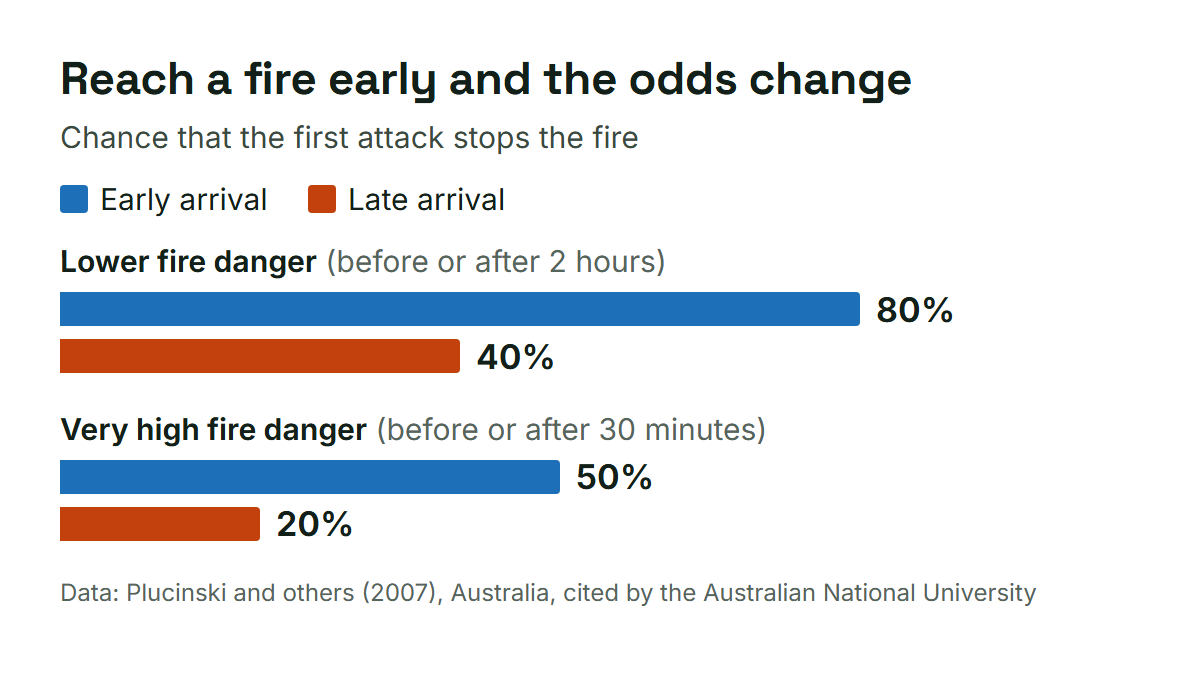
On the most extreme days, even a fast response succeeds only about 40% of the time. That is the strongest argument for speed there is: when every minute counts, none can be lost to a fire nobody has noticed.
Where fires are found and attacked quickly, most never make the news. The US Forest Service estimates that 98% of wildfires are put out before they reach 100 acres. The few that escape, the Australian study notes, account for the bulk of the cost.
The proof: it already works
- California: In 2024, a network of AI-assisted cameras picked up 1,668 wildfires, 636 of them before anyone called 911. After one 2:33 a.m. alert in July, crews stopped a fire within an area of 30 by 30 feet.
- The Pantanal: Tower cameras in the Serra do Amolar are designed to spot smoke within three minutes. The head of the institute that runs them said satellites would have taken about three days to find the first fire they caught. The cameras cover a little over 1 million hectares, a small part of the land at risk.
- Bolivia: In the Monte Verde Indigenous territory, trained brigades and early warning systems reduced fire damage for four years. In 2024, fires from outside grew beyond what they could fight, but the same network helped evacuate 520 people.
Monte Verde shows both sides. Early warning worked, year after year. What failed was everything around it: fires set elsewhere were not stopped while they were small, and arrived too big for local crews to fight.
What it takes
- See it: cameras, sensors, satellites and trained local observers watching the places where fires start.
- Share it: an alert with an exact location, sent to the people who can act, within minutes.
- Reach it: equipped crews close enough to arrive while the fire is still small.
- Prevent the next one: community education and fire-safe land management, so there are fewer sparks to find.
The same pattern runs through other disasters we have covered, from California's Camp Fire and the Maui wildfires to the 2023–2024 Australian bushfire season. The fires that take the most are the ones that outrun us at the start.
The next fire is still small
The 2024 South American wildfires were not only a story of drought. They were a story of time lost. Our conviction at Safeguard Nature is simple: a fire found in minutes is a fire that can be stopped, and what stood in its path can be saved. The technology exists. The people on the ground are ready. What is missing is the will to put early detection where it is needed, before the next dry season.
You can help. Learn about our mission, share this article, or support the fight against wildfires.
Frequently asked questions
How many acres burned in the 2024 South American wildfires?
About 182 million acres (73.7 million hectares), according to current GWIS satellite data. An earlier GWIS-based figure of 212 million acres (858,669 km²) is also widely quoted.
Which country was hit hardest?
Brazil had the largest area burned, 41.2 million hectares. Bolivia was hit hardest for its size: 16.5 million hectares, about double the year before. Chile lost the most lives.
What caused the 2024 wildfires in South America?
Severe drought, made worse by climate change, dried out the land. People started the great majority of the fires, mainly through land clearing, pasture burning and arson.
Could early detection have stopped the fires?
It could have stopped many of them. Australian research found that reaching a fire early at least doubled the chance of controlling it on the first attack in all but the most extreme conditions. Detection works when trained crews are ready to respond. The earlier a fire is found, the more lives, homes and forest can be saved.
Sources
- Global Wildfire Information System, via Our World in Data, Annual area burnt by wildfires (accessed November 2026)
- Kelley and others, Earth System Science Data, State of Wildfires 2024–2025 (2025), and Carbon Brief's summary
- Carbon Brief, 2024 Pantanal wildfires (2024)
- NASA Earth Observatory, An Unusual Year for Fire in Bolivia (2024)
- Australian National University, Measuring the economic impact of early bushfire detection (PDF; funded by a fire-detection company)
- Forests of the World, Forest Fires and Community Resilience in Bolivia (PDF, 2025)
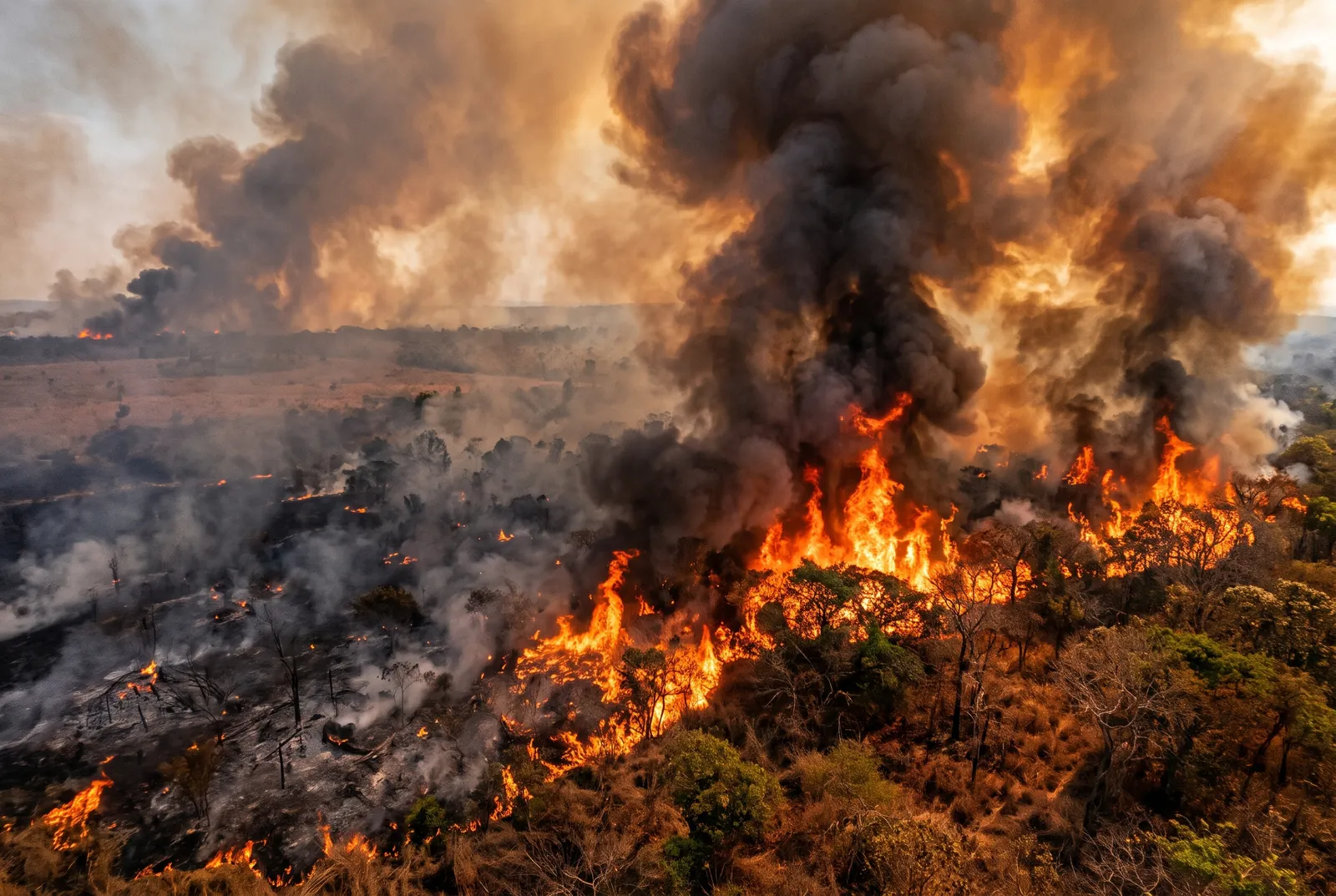
The picture at the top of this article is an AI-generated illustration.