Wildfire History
The 2021 Russian Wildfires: What Burned in Siberia, and the Case for Early Detection
In 2021, fire burned about 18 million hectares of Russia, and its smoke reached the North Pole. One crew saw the patrol plane four times in 50 days. Here is what burned, in charts and numbers, and what changed a year later when more people were watching.
In the summer of 2021, a fire crew was flown to a remote blaze in Yakutia, in Russia's far northeast. They stayed for 50 days. In that time, one of them recalled, they saw the forest service's patrol plane four times. It was supposed to pass at least twice a day. The 2021 Russian wildfires grew in gaps like that one. By the highest count they burned an area larger than Florida. Their smoke reached the North Pole. And they began as more than 14,000 separate fires, each of them small at first. Here is what burned, in charts and numbers, and what happened a year later when more people were watching.
- Land burned About 18 million hectares across Russia (182,000 km², or 45 million acres), by the highest count of forest fires.
- Worst hit Yakutia, also called Sakha: about 8 million hectares, the size of Austria.
- Fires About 14,200 on forest land, by the official count.
- Carbon About 970 million tons of CO2 equivalent in three months, more than Germany emits in a year.
- Smoke Reached the North Pole, more than 3,000 kilometers from Yakutia.
- Lives lost At least two people in the flames. The toll of the smoke is unknown.
Key takeaways
- Russia lost more trees to wildfire in 2021 than in any year since satellite records began in 2001.
- On July 10, 323 fires were burning in Yakutia. Crews were fighting 90. The rest lay in "control zones", where fires could legally be left to burn.
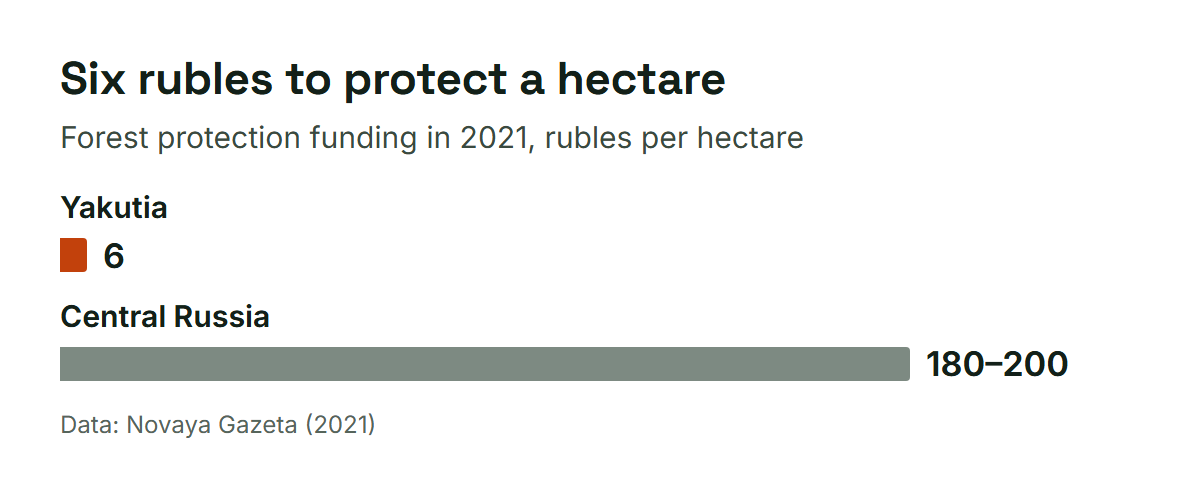
- The region received about 6 rubles per hectare to protect its forests. Central Russia received 180 to 200.
- In 2022, with more patrols, crews and money, the area burned by early August fell by 91%. Fires were being stopped, an official said, "literally from one stump".
- Early detection, backed by crews ready to respond, is the best chance to stop a fire while it is still small.
How much burned in the 2021 Russian wildfires?
The totals quoted most often run from about 78,000 to 182,000 km² (19 to 46 million acres). The low end is close to the count for Yakutia alone, and the high end covers the whole country. Totals also differ because some count all land and some only forest, and some count every hectare crossed by flames while others count only the trees that were lost.
| What was counted | Hectares | Acres |
|---|---|---|
| Russia: forest fires to September (Greenpeace, from official data) | 18.2 million | 45 million |
| Russia: all land, by satellite (Global Wildfire Information System) | 17.3 million | 43 million |
| Russia: forest land (Rosleskhoz, the forest agency) | 9.9 million | 24 million |
| Russia: tree cover lost to fire (Global Forest Watch) | 5.4 million | 13 million |
| Yakutia only: aerial forest service, cited by scientists | 9.4 million | 23 million |
| Yakutia only: NASA | 8.4 million | 21 million |
| Yakutia only: figure reported by Izvestia | 7.9 million | 20 million |
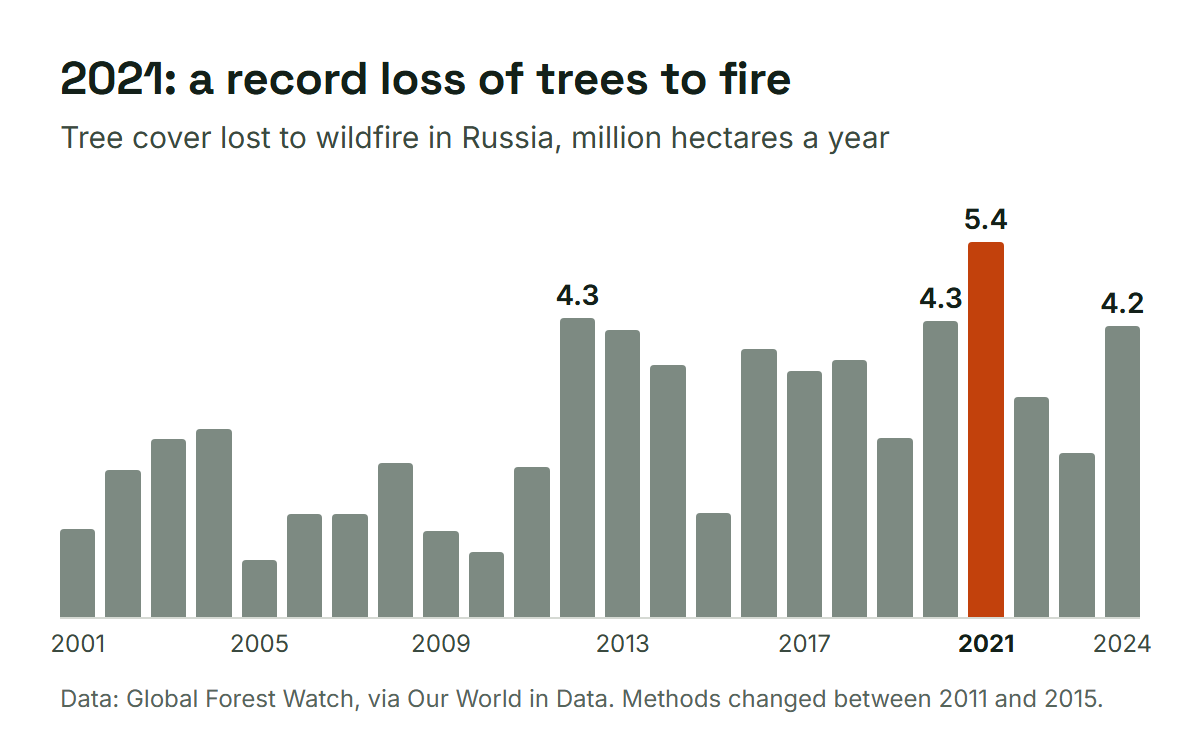
Was it a record? By tree loss, yes. Greenpeace's analysis of official data also makes 2021 the worst year since 2001. Other counts do not: the forest agency's own later figures put 2019 a touch higher, and satellite totals for all land show more in 2012 and 2014. In Yakutia there is little doubt: researchers call 2021 the worst fire season in four decades, and NASA put the area burned at nearly four times the average.
Timeline: how the fires spread
- May 30: Yakutia has 13 registered wildfires.
- July 9: In the Urals, fire reaches the villages of Dzhabyk and Zapasnoye. It destroys 72 buildings, and a 78-year-old resident dies.
- July 10: Yakutia now has 323 fires across more than a million hectares.
- July 20: The 320,000 people of Yakutsk are told to stay indoors.
- Early August: Smoke from Yakutia reaches the North Pole, more than 3,000 kilometers away.
- August 7: The village of Byas-Kyuel burns. A day later, Yakutia declares a state of emergency.
- August 9: Elbagi Igityan, a volunteer tractor driver, dies while cutting a firebreak.
- August 13: The head of the forest agency says fire has crossed more than 7 million hectares of Yakutia.
What caused the 2021 Russian wildfires?
Heat, drought and dry storms
Rain was scarce in Yakutia from May to July, and in the center of the region August was the second hottest in 43 years. From mid-June, dry thunderstorms set off fire after fire.
People
The season did not begin with lightning. From mid-May to mid-June there were more than 50 fires caused by people burning grass and logging waste, and all of them were next to settlements, an emergency ministry spokesperson said. From 2012 to 2020, fires started by people accounted for about half the area burned in Yakutia, and lightning fires for about a third. Some fires even smolder underground all winter and surface in spring.
Fires nobody was asked to fight
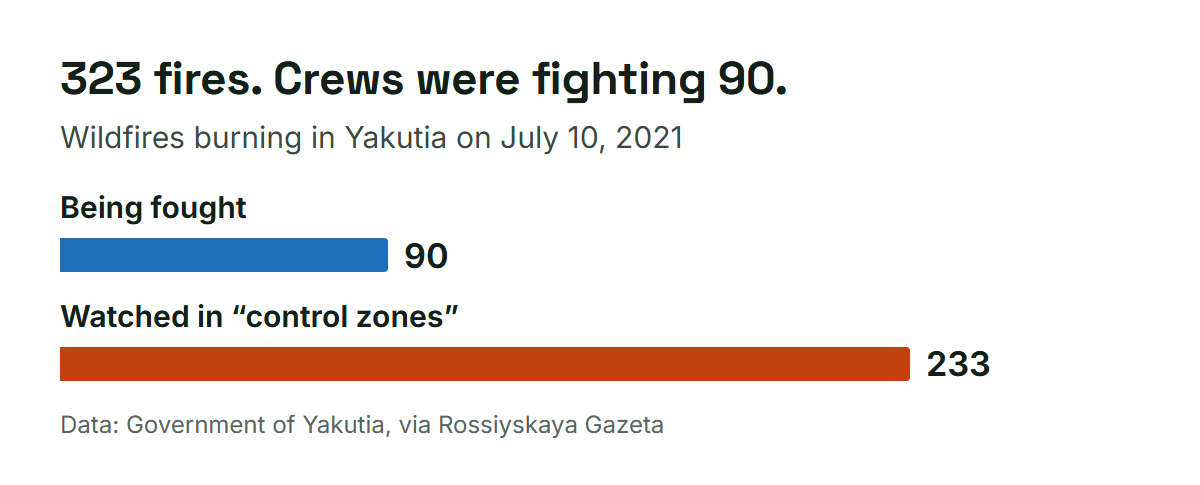
Since 2015, Russian regions have been able to leave a remote fire alone if fighting it would cost more than the damage it was expected to do. Almost half of Russia's forests were in these control zones. Elsewhere, crews were stretched thin. Yakutia's aerial fire service had about 1,600 people in 1988. In 2021 it had about 250 staff and 150 seasonal workers for a region roughly five times the size of France. Its chief pilot observer said the service would often watch a new fire until it became sizeable, and only then send a team.
The human and natural toll
In Yakutsk, fine particle pollution was reported at more than 40 times the safe guideline of the World Health Organization. Smoke plumes spread across as much as 10 to 12 million km². We found no full count of the illness and death that followed.
The climate paid too. Copernicus, the European Union's Earth observation program, estimated that Russia's fires released about 970 million tons of CO2 equivalent from June to August. Together, northern forests in Eurasia and North America released a record 1.76 billion tons in 2021, nearly twice as much as global aviation. In Yakutia, the fires also thawed permafrost and burned through layers of peat, releasing stored carbon and methane.
Byas-Kyuel: a week of watching
What happened to Byas-Kyuel, a village of about 600 people, shows how a distant fire becomes a disaster. For a week the flames were far off. Residents wet their roofs and kept watch at night. They were told the fire would be kept away from their homes. On August 6, a storm with winds of 20 meters per second turned it straight toward them.
The next morning about 100 men went out with shovels to dig a firebreak. After three hours they heard a roar. Within 20 minutes the fire was at their unfinished line. It took 31 houses and left 185 people, nearly a third of the village, without a home. Near Byas-Kyuel, several fires had merged into what Greenpeace Russia described as at least the third-largest single fire in recorded history.
That detail matters. A giant was made out of smaller fires. Each of them had a first day.
A hundred men with shovels could not stop that fire in August. A handful might have stopped each of the fires that fed it on the day it began. Had those fires been seen in their first hours, with a crew ready to go, many could have been put out, and the homes, the forests and the lives they took could have been saved.
How early detection could have changed the outcome
The evidence: what happened the very next year
After 2021, Yakutia's forest protection budget was raised about fivefold. Officials said patrol flying would rise fourfold, to 5,000 hours. The aerial fire service added 184 staff, opened three new units, and extended the protected area by 10 million hectares.
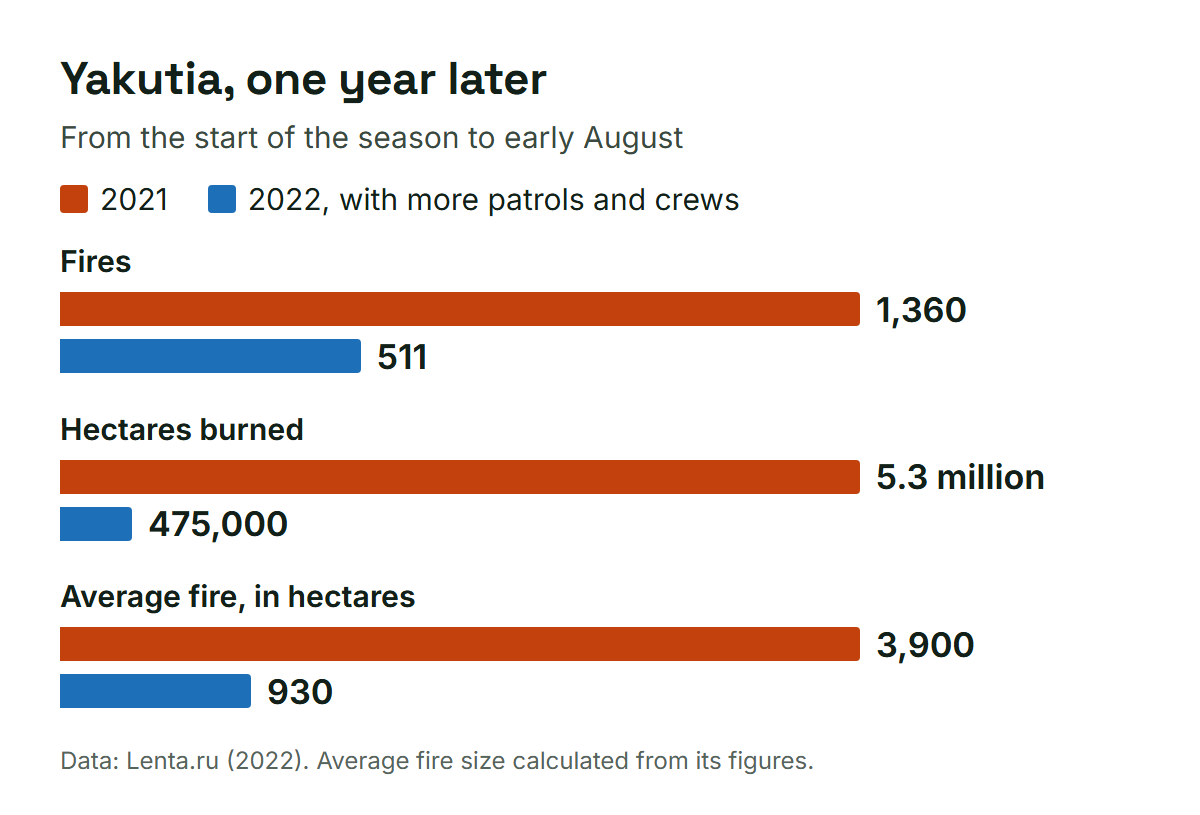
"Now we manage to detect and put out fires at an early stage, literally from one stump," said Yevgeny Perfilyev, the region's acting ecology minister. He added that satellites alone are not enough, because cloud can hide a fire from them.
Detection was not the only change. Weather differs from year to year, cloud seeding was used in May and June, and the region also had more crews to send. But the fall in average size is what you would expect to see when fires are caught sooner.
The proof: where forests are watched, fires stay small
- Moscow region: 198 forest fires in 2024, and every one was out within a day. The same was true in 31 other Russian regions.
- Yakutia: 1,006 fires in the same year, almost all in places that were hard to reach. They burned 3.3 million hectares.
- Russia as a whole: 67% of fires were put out within a day in 2024. In 2025, the forest agency reported 82.8%.
Roads, towns and shorter distances help in Moscow region, and so do more eyes. Research from Australia points the same way: in all but the most extreme conditions, crews who arrived early were at least twice as likely to stop a fire. And in Alaska, whose forests also stand on frozen ground, researchers found that fighting fires avoids CO2 emissions for about $13 a ton, comparable to or cheaper than many other climate solutions.
The warning: progress has to be kept up
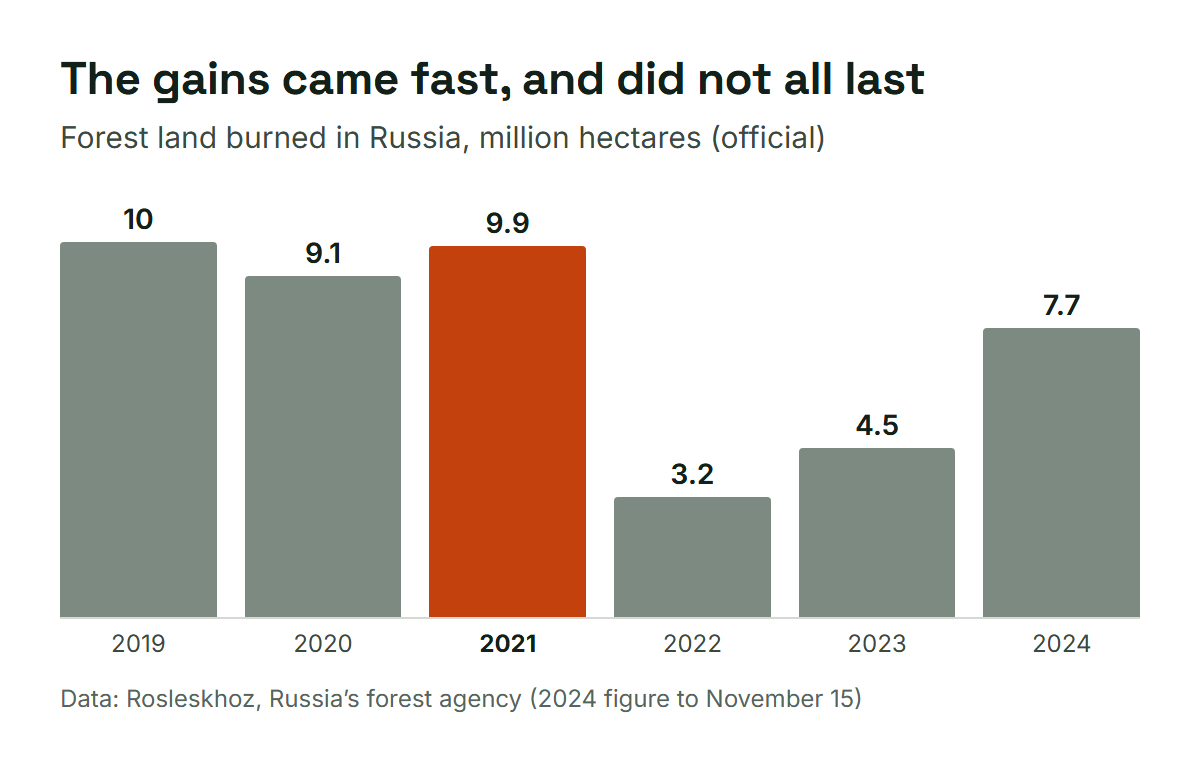
Watching the forest for one good summer does not settle the matter. A hot, dry, stormy year will test every gap that is left. The answer is to close the gaps.
What it takes
- See it: patrol aircraft, drones, cameras, sensors and satellites, each covering what the others miss.
- Share it: an exact location, sent within minutes to fire crews and to people in the fire's path. In 2021, seven settlements in Yakutia had no working sirens.
- Reach it: trained crews and aircraft close enough to arrive on the first day. Yakutia's heavy water bombers were based about 1,000 kilometers away.
- Prepare for it: firebreaks dug in spring, safe grass burning rules and fire-ready villages.
The same lesson runs through the 2023 Canadian wildfires, the 2024 South American wildfires and the 2023 Maui wildfires. The fires that take the most are the ones that outrun us at the start.
The next fire is still small
The 2021 Russian wildfires were born of heat and drought. They became a catastrophe because, across an immense forest, too few people were watching and too few could come. Our conviction at Safeguard Nature is simple: a fire found in minutes is a fire that can be stopped, and what stood in its path can be saved. The next great fire will begin as a single smoking stump. Someone has to see it.
You can help. Learn about our mission, share this article, or support the fight against wildfires.
Frequently asked questions
How many acres burned in the 2021 Russian wildfires?
The figures quoted most often run from about 19 to 46 million acres (78,000 to 182,000 km²). The high figure covers forest fires across all of Russia. The low one is close to counts for Yakutia alone.
What caused the 2021 Russian wildfires?
Extreme heat and drought dried out the forests. Early fires came mostly from people burning grass and logging waste. Lightning took over from mid-June. Many fires in remote "control zones" were left to burn.
How many people died in the 2021 Russian wildfires?
At least two deaths in the flames are documented here: a volunteer tractor driver in Yakutia and a 78-year-old resident in the Urals. We found no full count, and deaths linked to the smoke have not been totaled.
Could early detection have stopped the fires?
It could have stopped many of them. In 2022, when Yakutia expanded patrols, crews and funding, the area burned by early August fell by 91%. Weather played a part, and detection works only when crews are ready to respond.
Sources
- Novaya Gazeta, Yakutia burned because of six rubles (in Russian, 2021)
- Rosleskhoz, Results of the 2024 fire season (PDF, in Russian)
- Lenta.ru, report on Yakutia's air patrols, and Izvestia, report on the 2022 season (in Russian, 2022)
- NASA Earth Observatory, A Record-Breaking Year for Fire in Sakha (2021)
- Tomshin and Solovyev, Remote Sensing, Features of the Extreme Fire Season of 2021 in Yakutia (2022)
- Global Forest Watch, via Our World in Data, Tree cover loss from wildfires, and Global Wildfire Information System, Annual area burnt by wildfires (accessed November 2026)
- Vice, Russia's wildfires dwarfed all other fires across the world in 2021 (2021), including Copernicus emissions data
- Zheng and others, Science, Record-high CO2 emissions from boreal fires in 2021 (2023)
- Izvestia, report on the Urals villages (in Russian, 2021), and Wikipedia, 2021 Russian wildfires
The picture at the top of this article is an AI-generated illustration. It does not show the fires described here.