Wildfire History
The 2023 Canadian Wildfires: A Record Season, and the Case for Early Detection
In 2023, Canada lost more land to fire than in any year on record. The fire that emptied Yellowknife was already 56 hectares when it was found. Here is what burned, in charts and numbers, and how finding fires sooner could have changed the ending.
On June 28, 2023, a fire was discovered in the forest northwest of Yellowknife, in Canada's Northwest Territories. It was already 56 hectares. At that size, and with new fires breaking out all around, no crew was sent at once. Seven weeks later, that fire forced about 20,000 people to flee the city. It is the story of the 2023 Canadian wildfires in miniature: a season that burned more land than England, sent smoke across an ocean and cost eight firefighters their lives, built from fires that were each, for a short time, small enough to stop. This article sets out what burned, in charts and numbers, and how finding fires sooner could have changed the ending.
- Land burned About 15 million hectares in scientists' final estimates. The season count was 18.5 million (184,960 km²).
- Fires More than 6,500, from the Pacific to the Atlantic.
- People evacuated About 232,000, from more than 200 communities.
- Lives lost Eight firefighters, plus thousands of deaths linked to smoke.
Key takeaways
- 2023 was Canada's largest fire season on record, with more than double the area of the previous record year, 1989.
- Lightning started 59% of the fires, but those fires burned 93% of the land. Many began where nobody was watching.
- The fire that forced Yellowknife's evacuation was 56 hectares when it was found. It grew to more than 170,000.
- In Canada, about 3% of fires grow past 200 hectares, and they cause 97% of the area burned. Stopping the few that escape is what matters most.
- Early detection, with crews ready to respond, is the best chance to stop a fire before it joins that 3%.
How much burned in the 2023 Canadian wildfires?
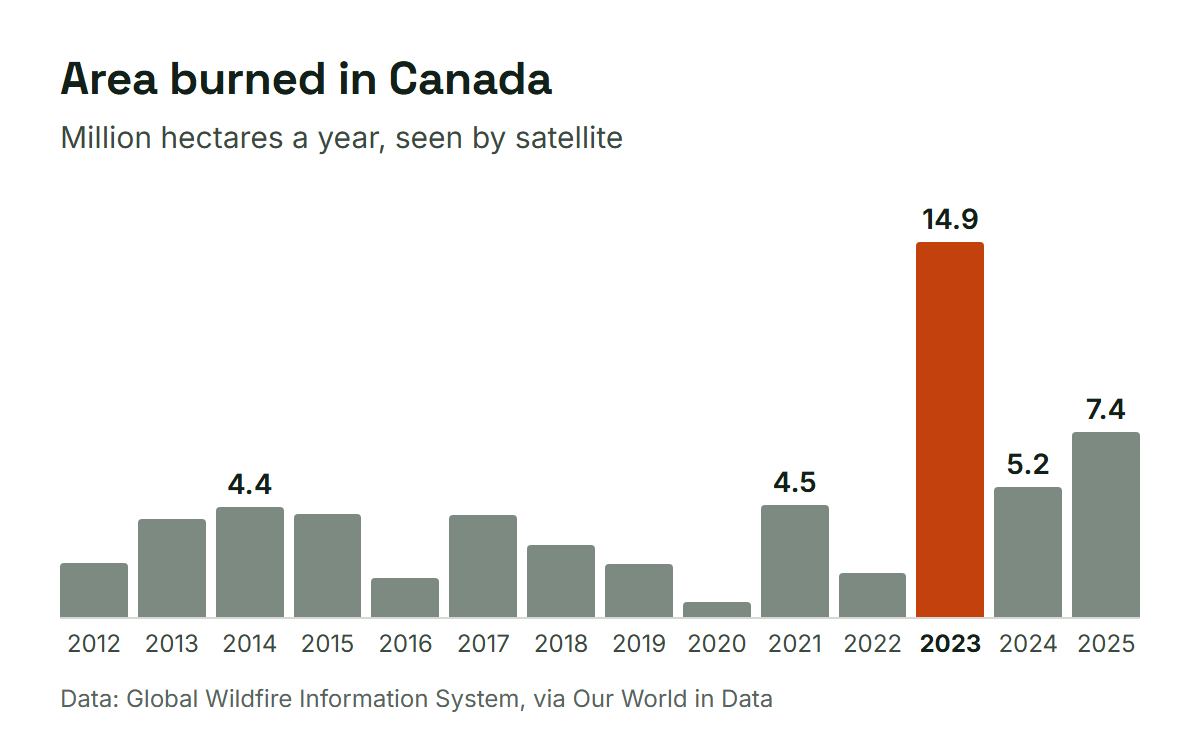
The figure quoted most often is 184,960 km² (18.5 million hectares, or 45.7 million acres). It comes from the Canadian Interagency Forest Fire Centre (CIFFC), which counts fires as they burn, and appears in a federal briefing. Burn scars were later mapped more precisely. The totals came down, but the record stands by a wide margin.
| Source | Hectares | Acres |
|---|---|---|
| CIFFC, season count | 18.5 million | 45.7 million |
| CIFFC, later figure | 17.2 million | 42.5 million |
| Jain and others, Nature Communications (2024) | About 15 million | About 37 million |
| Global Wildfire Information System (satellite) | 14.9 million | 36.8 million |
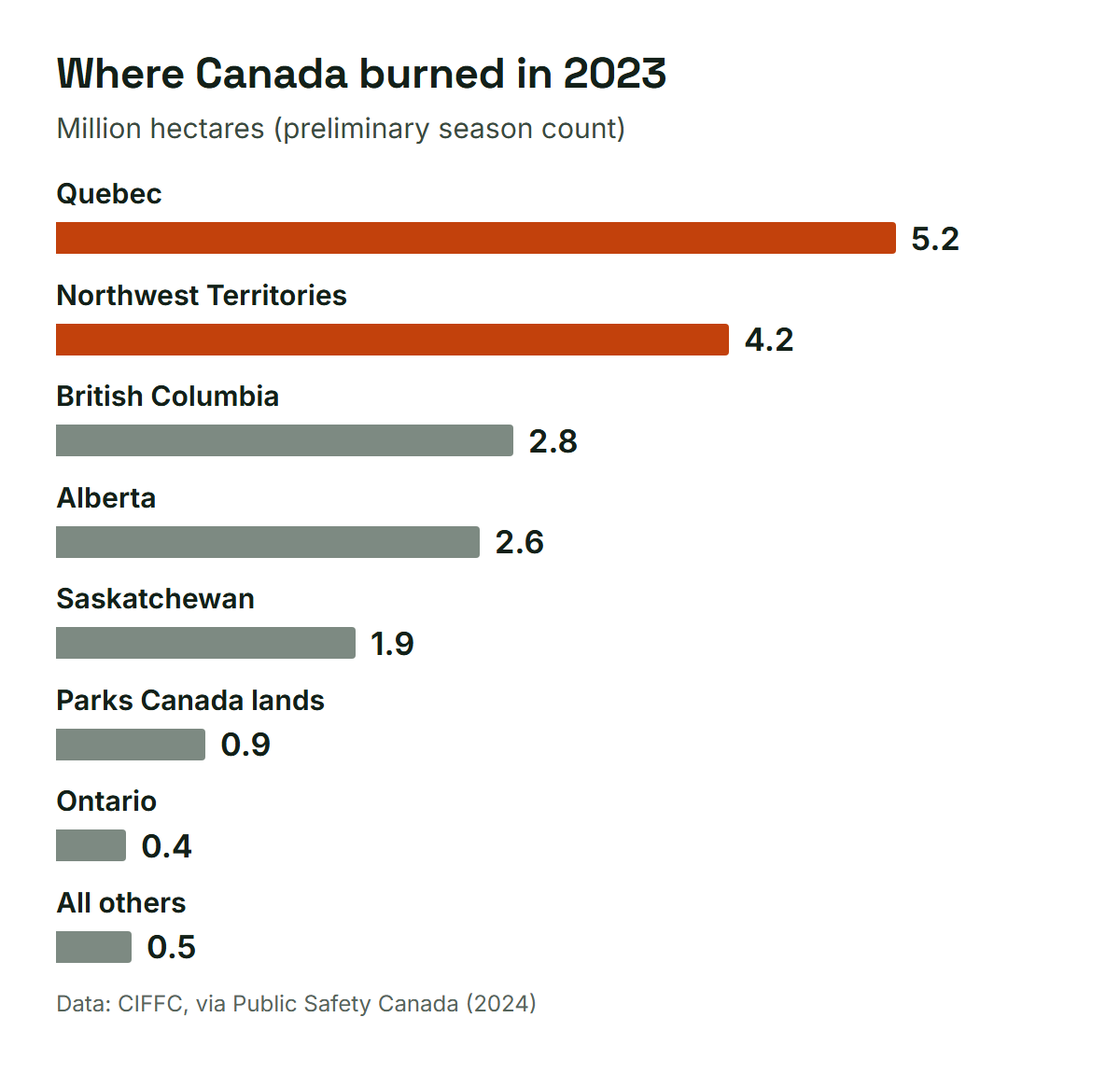
Province by province
Timeline: how the season unfolded
- May 6: Alberta declares a state of emergency.
- May 11: Canada raises its national preparedness to the highest level. It stays there until September.
- May 28: A fire in Upper Tantallon, near Halifax, forces more than 16,000 people out. At least 200 properties, including 151 homes, are destroyed or damaged.
- June 18: Donnie Creek becomes the largest single wildfire in British Columbia's history.
- August 13: Fire destroys about 80% of Enterprise, Northwest Territories.
- August 15–18: The McDougall Creek and Bush Creek East fires break out or surge in British Columbia. Together they cause more than C$720 million in insured damage.
- August 16: Yellowknife is ordered to evacuate.
What caused the 2023 Canadian wildfires?
Heat and drought
Snow melted early, drought gripped the west for years, and the east dried out within weeks. From May to October, temperatures ran about 2.2°C above the 1991–2020 average. Researchers found that climate change enabled the sustained extreme fire weather.
Lightning where nobody was looking
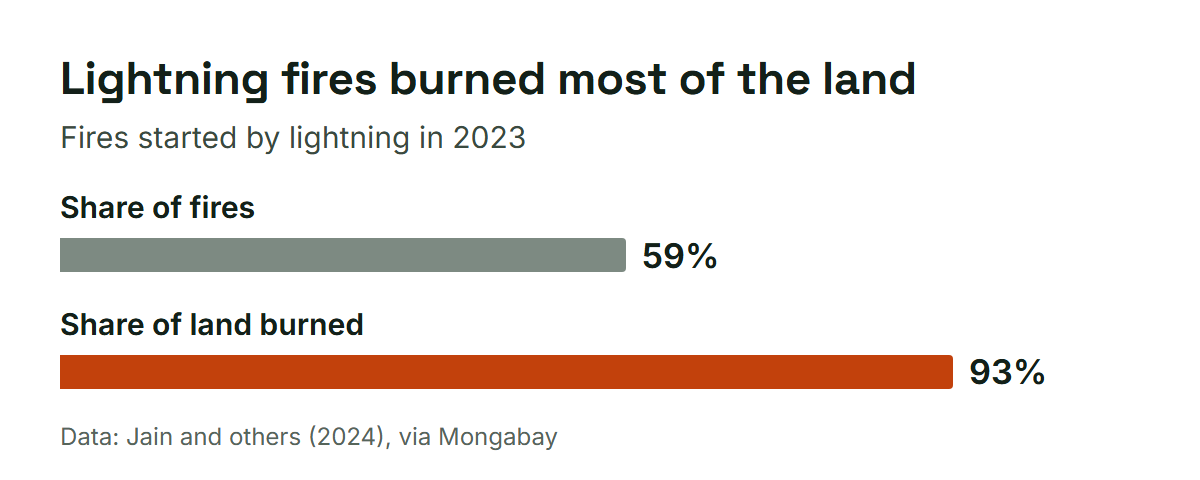
Near towns, people see smoke and call. In British Columbia, the public reports more than 40% of wildfires. In the far north there may be nobody to call. A lightning strike can smolder for hours or days before anyone knows it is there, and by then the fire may be too big for one crew. These lightning fires are exactly the ones that cameras, sensors and satellites are suited to find.
The human and natural toll
Eight firefighters died. About 232,000 people left their homes. In the Northwest Territories, more than two-thirds of the population of 45,000 was evacuated.
The smoke reached much further. A 2025 study in Nature estimates that 354 million people in North America and Europe were exposed to fine particle pollution from the fires. It attributes about 5,400 deaths in North America to short-term exposure, and about 64,300 in North America and Europe to long-term effects.
The fires released about 647 million tons of carbon, more than four times Canada's annual fossil fuel emissions. Nearly 4% of the country's forests burned in a single season.
The fire that emptied Yellowknife
An independent review traced what happened to the fire known as ZF015. Lightning started it. When it was discovered at 5 p.m. on June 28, it already covered 56 hectares. The review explains why no crew was sent immediately: the fire was "relatively large at detection", conditions were extreme, and new fires elsewhere were threatening communities. It looked remote. It was left to be watched.
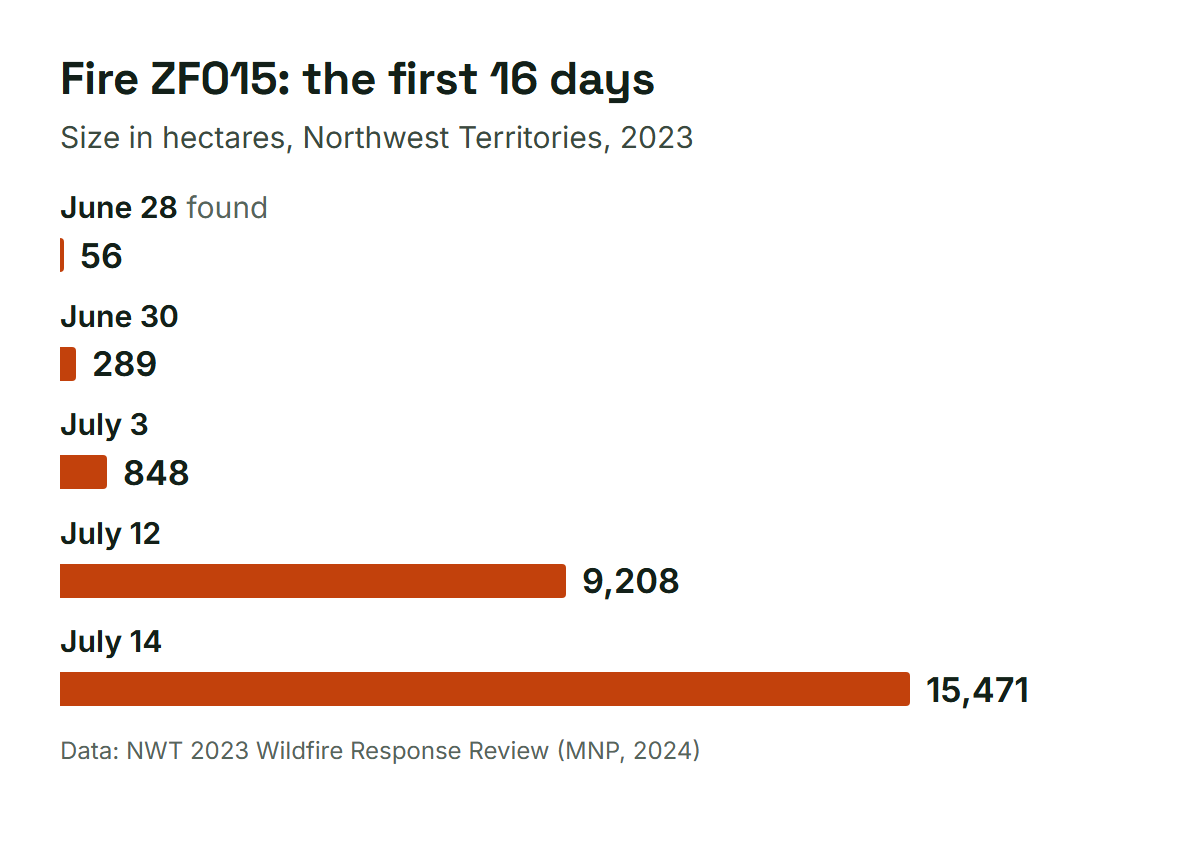
By July 15, the military was on the fire line. On July 24, the community of Behchokǫ̀ was evacuated, and four homes there were lost. On August 16, with the fire 15 to 20 kilometers away, Yellowknife emptied. The fire reached 170,786 hectares before it was contained in September.
Compare that with the goal set in neighboring Alberta: to attack a fire before it grows larger than 2 hectares. ZF015 was 28 times that size when it was found.
Nobody chose to let a fire take a city's summer. By the time the choice was made, the cheap options were gone. Had fires like ZF015 been seen when they were the size of a campsite, with a crew ready to fly, many could have been stopped, and the homes, forests and lives they went on to take could have been saved.
Why every hectare counts
The fire that destroyed Enterprise shows how narrow the window is. A patrol aircraft found it on August 2 at just 3 hectares, and crews attacked soon after. But the forest was so dry that it had reached 20 hectares when they began and 80 by nightfall. Eleven days later, driven by winds above 90 km/h, it burned through the town. In a year like 2023, even a prompt response can be too late. That is not a reason to give up on early detection. It is the reason to detect fires at the first wisp of smoke, not at three hectares and not at 56.
How early detection could have changed the outcome
The evidence: stop the 3%
Natural Resources Canada reports that only about 3% of wildfires grow beyond 200 hectares, yet they account for 97% of the area burned. The rest stay small. The whole disaster lives in that difference, and time is a large part of what separates the two.
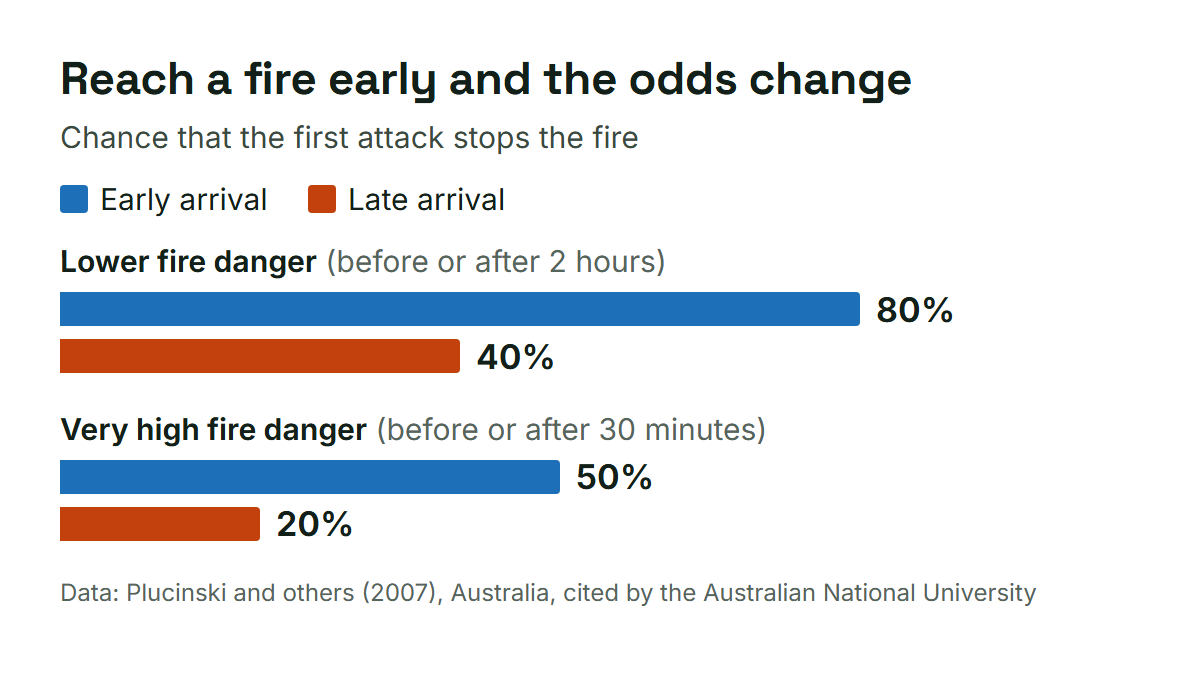
Australian research reviewed by the Australian National University found that, below the most extreme conditions, crews who reached a fire early were at least twice as likely to stop it. A crew can only arrive early if the alarm does.
The proof: it already works
- British Columbia: Within hours of being switched on in 2024, a pilot network of cameras spotted a fire and had crews on the way 16 minutes before any of the wildfire service's other networks noticed it.
- Alberta: Staffed lookout towers find about 30% of the province's wildfires. A 2022 fire near a tower that had been closed was found by aircraft at 30 hectares and reached 90 by day's end. A former lookout argues that the tower would have caught it at a hundredth of a hectare.
- California: In 2024, AI-assisted cameras picked up 636 wildfires before anyone called 911.
No single tool is enough. In an Alberta trial, a human lookout outperformed six automated systems. The best protection combines them: trained eyes, cameras, sensors and satellites, covering each other's blind spots.
Warning people in time
Detection also buys time to escape. In Upper Tantallon, the first emergency alert went out about an hour and 44 minutes after police were called to the fire. Nobody died there, but minutes like those decide whether people leave in daylight or through flames.
What it takes
- See it: cameras, sensors, satellites and lookouts watching the places where lightning strikes and people gather.
- Share it: an alert with an exact location, sent within minutes to fire crews and to people in the fire's path.
- Reach it: enough trained crews and aircraft to attack several new fires on the same day.
- Prepare for it: fire-safe communities and careful fuel management, so a fire that does escape has less to burn.
The same lesson runs through the 2024 South American wildfires, the 2023 Maui wildfires and California's Camp Fire. The fires that take the most are the ones that outrun us at the start.
The next fire is still small
The 2023 Canadian wildfires were a story of heat, drought and lightning. They were also a story of time. Our conviction at Safeguard Nature is simple: a fire found in minutes is a fire that can be stopped, and what stood in its path can be saved. Somewhere, the next great fire will begin as a thread of smoke. Whether it ends there depends on who is watching.
You can help. Learn about our mission, share this article, or support the fight against wildfires.
Frequently asked questions
How many acres burned in the 2023 Canadian wildfires?
The season count was 45.7 million acres (18.5 million hectares, or 184,960 km²). Later mapping lowered the total to between about 37 and 42.5 million acres, still more than double the previous record.
What caused the 2023 Canadian wildfires?
Heat and drought, made worse by climate change, dried out the forests. Lightning started 59% of the fires, which burned 93% of the land. People started most of the rest.
How many people died in the 2023 Canadian wildfires?
Eight firefighters were killed. A 2025 study also attributes about 5,400 deaths in North America to short-term smoke exposure and about 64,300 in North America and Europe to long-term effects.
Could early detection have stopped the fires?
It could have stopped many of them. About 3% of Canada's fires cause 97% of the area burned, and research shows that reaching a fire early at least doubles the chance of stopping it in all but the most extreme conditions. Detection works when trained crews are ready to respond.
Sources
- MNP for the Government of the Northwest Territories, 2023 Wildfire Response Review (PDF, 2024)
- Public Safety Canada, Parliamentary Committee Notes: Canadian Wildfires (2024)
- Jain and others, Nature Communications, Drivers and Impacts of the Record-Breaking 2023 Wildfire Season in Canada (2024)
- Zhang and others, Nature, Long-range PM2.5 pollution and health impacts from the 2023 Canadian wildfires (2025)
- Global Wildfire Information System, via Our World in Data, Annual area burnt by wildfires (accessed November 2026)
- The Narwhal, What causes wildfires in Canada, and Wikipedia, 2023 Canadian wildfires
- Australian National University, Measuring the economic impact of early bushfire detection (PDF; funded by a fire-detection company)
The picture at the top of this article is an AI-generated illustration. It does not show the fires described here.