Wildfire History
The 2023–2024 Australian Bushfire Season: Causes, Impact and Lessons
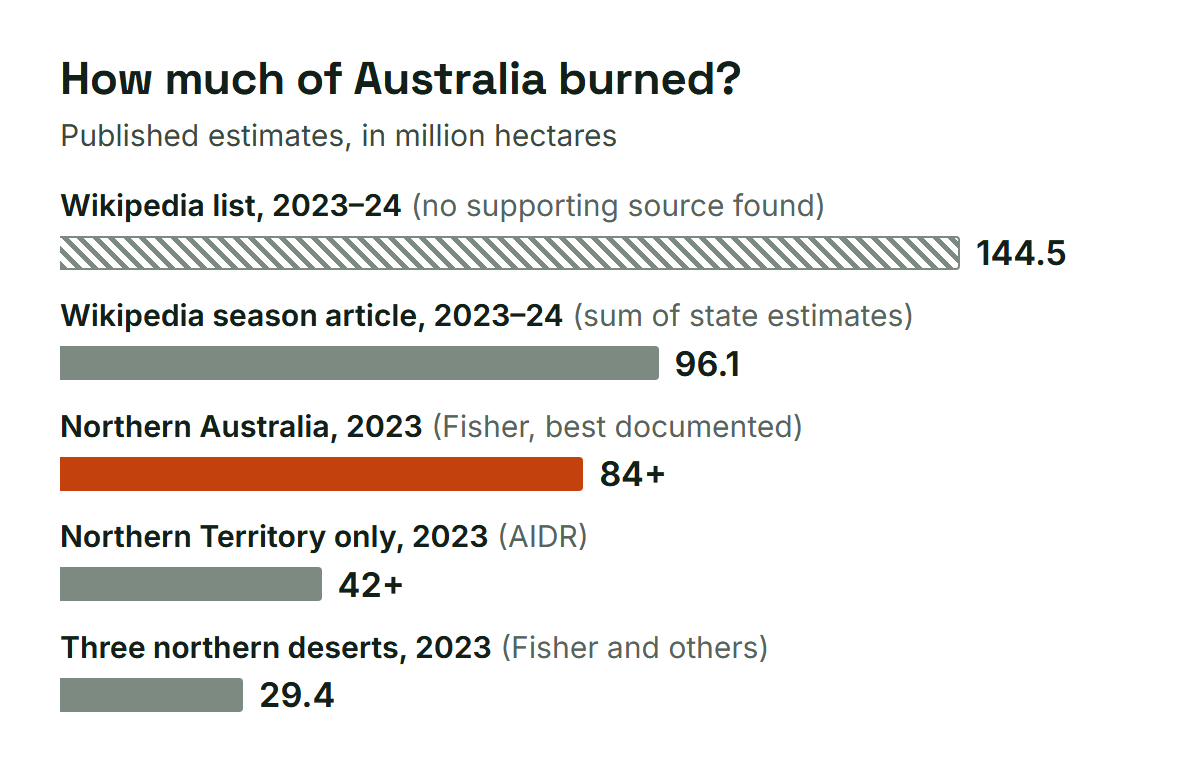
In 2023, an estimated 84 million hectares of northern Australia burned, about eight times the area of forest burned in Black Summer. Yet the fires that took the most homes were far smaller. Here is what burned, why, and what the season taught us.
The 2023–2024 Australian bushfire season was two very different disasters at once. In the north, fire crossed an area of desert and savanna larger than the whole state of New South Wales, and much of the world barely noticed. Further south and east, smaller fires in farmland, forest and suburbs took lives and destroyed homes. This article explains what burned, why it burned, and what the season taught fire managers.
Key takeaways
- The best-documented estimate is that more than 84 million hectares (about 840,000 km², or 208 million acres) of northern Australia burned in 2023.
- A figure of 1,445,372 km² (about 357 million acres) for the whole season is widely repeated, but we could not trace it to a source that supports it.
- The fuel came from rain: wet La Niña years grew vast, continuous grass, which then dried out.
- The greatest human losses came from much smaller fires. In and around Tara, Queensland, two people died, and 63 houses were lost across the South West Region. In Pomonal, Victoria, 45 homes were destroyed.
- Planned burning by Indigenous rangers helped check some of the largest desert fires.
How much land burned in the 2023–2024 Australian bushfire season?
There is no single official national total. The answer depends on the region, the dates and the satellite data used.
| Estimate | Area | What it covers |
|---|---|---|
| Wikipedia, list of largest fires | 1,445,372 km² (357 million acres) | 2023–2024 season; we found no source that supports it |
| Wikipedia, season article | 960,819 km² (237 million acres) | Sum of state and territory estimates |
| Rohan Fisher, Charles Darwin University | More than 84 million ha (840,000 km²) | Desert and savanna in northern Australia, 2023 |
| Australian Institute for Disaster Resilience (AIDR) | More than 42 million ha (420,000 km²) | Northern Territory only, 2023 |
| Fisher and colleagues, 2025 | 294,393 km² (73 million acres) | Three northern desert bioregions, 2023 |
Why we treat the 1.4 million km² figure with caution
An area of 1,445,372 km² would be almost 19% of the Australian continent. The number appears on Wikipedia's list of the largest fires of the 21st century, but Wikipedia's own article on the season gives a total a third smaller. The list cites a November 2023 Guardian interactive, which reported that about 610,000 km² had burned in the north by that point: an area larger than Spain, but less than half of 1.4 million km².
The 84 million hectare estimate comes from a fire researcher and is repeated in AIDR's national Major Incidents Report. Even so, it is an estimate. National fire monitoring by the Australian National University reports much lower annual totals, so the method matters as much as the number.
What caused the 2023–2024 bushfires?
Rain came first
It seems backwards, but Australia's biggest desert fires follow rain. Northern Australia's 2022–23 wet season was its sixth wettest since 1900–01. Grass grew across country that is normally too sparse to carry fire over long distances, and once it dried it formed an almost unbroken fuel bed. Fisher describes La Niña as the major driver of these fires. The previous great fire year in the deserts, 2011, also followed heavy rain.
Then the rain stopped
August to October 2023 was the driest three-month period recorded in Australia since 1900. On September 19, the Bureau of Meteorology declared that El Niño and a positive Indian Ocean Dipole were both under way, a pairing that tends to dry out the continent. The same El Niño worsened drought in Hawaii in the months around the 2023 Maui wildfires. In Australia, July to December 2023 was the warmest such period on record, at 1.69°C above the 1961–1990 average, and unusually strong easterly winds pushed fires across the north.
Lightning and people lit the fires
From September to November 2023, sensors recorded more than 1.1 million ground lightning strikes across three desert bioregions. Arson was widely blamed in the media, but researchers found that lightning alone was enough to explain the desert fires. Lightning also set off California's 2020 Bay Area fires. Elsewhere in Australia, people were responsible: in Gippsland, Victoria, burn-offs on private land started the Briagolong and Rawson fires.
What about climate change?
Climate change is raising fire danger across much of Australia, but Fisher concluded that it was not the main cause of the 2023 desert fires. Fuel was. The same team notes that projections point to higher and more variable rainfall in the region, which could mean more of these boom-and-burn cycles.
Timeline of the major fires
August–October 2023: Barkly Fire Complex, Northern Territory
A fire east of Tennant Creek was reported on August 28. Two fires merged on September 5, and on September 12 an emergency was declared as wind drove a 200 km fire front toward the town of about 3,000 people. Bushfires NT, an agency of roughly 40 people, was joined by pastoralists, volunteers, defense personnel and crews from South Australia and New South Wales. Water bombers were used in the Territory for the first time, and crews lit backburns more than 200 km long.
The complex was declared out on October 23 after burning 2.8 million hectares (6.9 million acres). Across the Territory, 903 wildfires were recorded in 2023, up from 472 the year before.
September–November 2023: New South Wales
New South Wales had a widespread spring season, with more than 65 incidents burning at once at its height. A lightning storm near Tenterfield in late October started more than 60 new fires. In November, the Hudson fire burned 27,894 hectares in the opal fields near Lightning Ridge, destroyed 24 properties and cost one firefighter's life.
September 2023–January 2024: South West Queensland
Fires in Queensland's South West Region burned 251,976 hectares and destroyed more than 130 structures, including 63 houses. The fire at Tara was first reported on October 15. A man died on October 24 while trying to protect his property, and a woman died the next day after a medical episode while evacuating.
October–November 2023: the Western Australian and Territory deserts
The fastest-moving fires of the season ran through spinifex. In the Tanami, 29,928 km² burned in five days from October 22. In the Great Sandy Desert, 27,732 km² burned in five days in early November. Each run covered an area larger than the US state of Vermont. Also in November, a fire at Mariginiup, on Perth's northern fringe, burned about 1,900 hectares and destroyed 18 homes.
February 2024: western Victoria
On February 13, Victoria faced its first Catastrophic fire danger rating since 2019–20. Lightning started the Bellfield and Mt Stapylton fires in and around the Grampians. Together they burned only 6,418 hectares, but the Bellfield fire reached Pomonal and destroyed 45 homes and one business. Another home was lost at Dadswells Bridge. Nine days later, the Bayindeen–Rocky Road fire near Ballarat broke out, burning 21,664 hectares and six homes.
Impact on people and nature
One compilation puts the toll of the Australian bushfire season at 10 deaths and more than 170 homes, although its own state figures do not add up exactly. What is clear is that area burned is a poor measure of harm. The Pomonal fire was a tiny fraction of the size of the Barkly complex, yet it destroyed much of a township. California learned the same lesson in 2018, when the Camp Fire killed 85 people in an area of just 153,336 acres.
That does not make the northern fires harmless. They threatened remote Aboriginal communities and outstations, closed the Barkly Highway, knocked out communications and burned through cattle country. The deserts are also home to threatened animals such as the greater bilby, night parrot and great desert skink, and researchers say the loss of traditional burning there may have contributed to biodiversity losses.
How it compares with Black Summer
The 2019–20 Black Summer burned roughly 10 million hectares of forest in Australia's south and east, so the 2023 northern fires covered about eight times that area. National totals for 2019–20, which count other regions too, run considerably higher. The comparison needs care. Black Summer burned dense forest close to where millions of people live: the fires killed 33 people and destroyed more than 3,000 homes. Grass and spinifex carry far less fuel per hectare and recover faster.
Nor was 2023 unprecedented. More than 55 million hectares burned in the Northern Territory in 2011, compared with about 43 million in 2023. In the three northern deserts studied by Fisher's team, 2023 was the second-largest fire year in 24 years of satellite mapping, after 2011. The State of Wildfires 2023–2024 project placed the season among Australia's five largest by burned area since 2002.
Lessons from the Australian bushfire season
- Wet years are a warning. Heavy rain in the arid interior signals fire danger a year or more ahead, which leaves time to prepare.
- Planned fire works. Since 2019, Indigenous ranger teams have carried out large-scale cool-season burning in the Great Sandy Desert. A 2025 study found that a major 2023 fire there was repeatedly blocked and rerouted by earlier burns. In the Davenport Murchison Ranges, with little earlier burning, a fire ran for more than 60 days and burned 25,000 km².
- Remote regions need capacity. AIDR's review of the Barkly fires points to distance, fatigue, poor communications and late deployment of management teams.
- Small fires need speed. On a Catastrophic day, the time between ignition and the first house can be very short. Early detection, early warnings and early evacuation save lives.
Safeguard Nature works for a fire-safe future through international collaboration, community education and technology. You can learn more about our mission or support the fight against wildfires.
Frequently asked questions
How many acres burned in the 2023–2024 Australian bushfire season?
The best-documented estimate is more than 84 million hectares, about 208 million acres, in northern Australia in 2023. Figures as high as 357 million acres (1,445,372 km²) circulate online, but we could not find a source that supports them.
What caused the 2023 fires in northern Australia?
Several wet years grew unusually large amounts of grass. Record dryness from August to October 2023, heat and strong winds then made it ready to burn, and lightning was sufficient to ignite the desert fires.
Was 2023–2024 worse than Black Summer?
It was larger in area but less destructive. Black Summer burned far more forest and destroyed far more homes. The 2023 fires burned mostly grassland and desert in sparsely populated country.
Which places lost the most homes?
Among the fires covered here, the heaviest losses were in South West Queensland, where 63 houses were destroyed, and Pomonal, Victoria, where 45 were. Mariginiup, near Perth, lost 18.
Sources
- Australian Institute for Disaster Resilience, Major Incidents Report 2023–24 (PDF)
- Rohan Fisher, The Conversation, 84 million hectares of northern Australia burned in 2023 (2024)
- Fisher, Legge, Catt and Cliff, International Journal of Wildland Fire, Extensive fires in Australia's northern spinifex deserts (2025)
- Earth System Science Data, State of Wildfires 2023–2024 (2024)
- ANU and TERN, Australia's Environment: Fire